
UNESCO World Heritage Site · Sundarbans, West Bengal
Sundarban Wildlife Photography Tour Package 2026
Royal Bengal Tiger · 260+ Bird Species · 5AM–5PM Full-Day Safari · Max 8 Guests
Starting From – 3N/3D from ₹11,000 · 4N/4D from ₹14,000 per head
Bird Species
0
+
Bengal Tigers
0
+
Daily Safari Start
5
AM
Guests Per Tour
0
Max
About This Tour
India's Most Spectacular Wildlife Photography Destination
The Sundarbans is a UNESCO World Heritage Site — the world’s largest tidal mangrove forest and the only ecosystem on Earth where the Royal Bengal Tiger lives in a tidal habitat. This makes it the most extraordinary wildlife photography destination in India.
Our Sundarban wildlife photography tour is a dynamic expedition, not a fixed sightseeing tour. Every day’s route is decided based on tiger movement, tide condition and fresh tracking signs. Starting from Kolkata — just 3.5 hours away — safaris run 5 AM to 5 PM daily.
- Professional wildlife photographer guide every day
- 5 AM–5 PM full-day safari — sunrise to sunset
- Maximum 8 guests — no crowds, no blocked shots
- Neap Tide date selection for best conditions
- 65 ft wooden boat with upper-deck photo platform
- 3N/3D & 4N/4D options from Kolkata or Godkhali



Tour Plans
3N/3D & 4N/4D Photography Tour Itinerary
This is a dynamic wildlife expedition — not a fixed itinerary. Every day’s route is decided based on fresh pugmarks, alarm calls, tide condition and real-time guide intelligence.
🔵 3 Nights / 3 Days
| Day | Activities |
|---|---|
| Day 0 Arrival | Arrival at Godkhali — Check-in & Briefing Reach Godkhali at Evening, boat transfer to Pakhiralay / Dayapur resort. Welcome Bengali dinner. Full briefing on tiger tracking, tide calendar, safety protocol and photography strategy. |
| Day 1 Safari | First Forest Entry — Creek Exploration & Full-Day Safari Pre-dawn departure 5:00 AM. Route chosen on overnight guide intelligence. Cover creek systems, Core Zone channels, watchtower zones. Subjects: tiger tracking, kingfisher perches, eagle hunting, mangrove sunrise. Evening: Bonbibi folk & Jhumur dance. |
| Day 2 Deep | Deep Forest Tracking — Wait & Watch Sessions Completely different route. Extended silent stalking: engine off, 30–60 min at creek junctions. Subjects: saltwater crocodiles, Irrawaddy dolphins, spotted deer, golden-hour bird photography. Classic Sundarban sunset shot. |
| Day 3 Exit | Final Tracking Session & Return Alternate routes not yet covered. Morning photography in best early light. Photographer guide reviews your best shots en route. Return to Kolkata. |
⭐ 4 Nights / 4 Days (Recommended)
| Day | Activities |
|---|---|
| Day 0 Arrival | Arrival + Evening Bird Photography Session Check-in and lunch. Afternoon 1–2 hr country boat ride for evening bird photography in golden-hour light. |
| Day 1 Safari | First Forest Entry — Core Zone & Watchtower Circuit 5:00 AM departure. Core Zone channels, watchtower circuit (Sajnekhali, Sudhanyakhali, Dobanki). Full-day tracking with pugmarks read at every mud bank, alarm calls followed. |
| Day 2 Deep | Deep Tracking — High-Probability Creeks Completely different route. Highest-probability creeks from Day 1 data. Extended silent stalking sessions. Crocodile, Irrawaddy dolphin, deer herds, golden-hour dusk photography. |
| Day 3 Buffer | Buffer Zone — Panchomukhani & Village Photography Exclusive 4N advantage. Panchomukhani (Five River Junction), Pirkhali, Sundarkhali, Sarakkhali. Village photography: fishermen, honey collectors (Moulis). Macro on mangrove roots and fiddler crab mudflats. |
| Day 4 Exit | Short Final Session & Return Morning session for remaining shot list. Final kingfisher perch sessions, macro photography in morning light. Photographer guide reviews your best images en route back to Kolkata. |
Neap Tide Date Planning
2026–2027 Perfect Tour Date Calendar
No competitor publishes this. We plan every tour batch around real tide patterns — Neap Tide (Mra Kotal) gives a stable boat, clear water reflections, and better wildlife visibility.
| Month | Dates | Days | Status |
|---|---|---|---|
| June 2026 | 5 – 8 | Fri → Mon | ✅ Good |
| July 2026 | 8 – 11 | Wed → Sat | ✅ Good |
| August 2026 | 5 – 8 | Wed → Sat | ✅ Good |
| October 2026 | 2 – 5 | Fri → Mon | 🔥 Peak Season |
| November 2026 | 18 – 21 | Wed → Sat | ⭐ Best Season |
| December 2026 | 2 – 5 | Wed → Sat | ⭐ Best Season |
| December 2026 | 18 – 21 | Fri → Mon | ⭐ Best — Rates Higher |
| January 2027 | 1 – 4 | Fri → Mon | ⭐ Peak Premium |
| January 2027 | 15 – 18 | Fri → Mon | ⭐ Best Season |
| February 2027 | 12 – 15 | Fri → Mon | ✅ Excellent |
| ⚠️ Avoid: Amavasya ±2 days — 15 Jun, 14 Jul, 12 Aug, 10 Sep, 9 Oct, 7 Nov, 6 Dec 2026 | Forest closed every Tuesday | |||
Package Pricing 2026–2027
Photography Tour Rate Chart
All-inclusive: meals, full-day boat safari, expert photographer guide, forest permits, premium accommodation & transfers. ₹11,000/head onwards.
🚤 Godkhali to Godkhali
3 Nights / 3 Days
3 Nights / 3 Days
| Group Size | Per Head |
|---|---|
| 8 Persons | ₹11,000 |
| 6 Persons | ₹13,200 |
| 4 Persons | ₹17,800 |
| 2 Persons | ₹31,500 |
| 1 Person | ₹60,800 |
🚗 Kolkata to Kolkata
3 Nights / 3 Days
3 Nights / 3 Days
| Group Size | Per Head |
|---|---|
| 8 Persons | ₹12,500 |
| 6 Persons | ₹14,700 |
| 4 Persons | ₹19,500 |
| 2 Persons | ₹34,500 |
| 1 Person | ₹66,800 |
RECOMMENDED
🚤 Godkhali to Godkhali
4 Nights / 4 Days
4 Nights / 4 Days
| Group Size | Per Head |
|---|---|
| 8 Persons | ₹14,000 |
| 6 Persons | ₹17,000 |
| 4 Persons | ₹22,700 |
| 2 Persons | ₹39,800 |
| 1 Person | ₹77,000 |
BEST VALUE
🚗 Kolkata to Kolkata
4 Nights / 4 Days
4 Nights / 4 Days
| Group Size | Per Head |
|---|---|
| 8 Persons | ₹15,500 |
| 6 Persons | ₹18,500 |
| 4 Persons | ₹24,500 |
| 2 Persons | ₹42,800 |
| 1 Person | ₹83,000 |
Single Room Supplement: ₹4,000 (3N) / ₹5,500 (4N) | Peak Season surcharge applies Dec 18–21, 2026 & Jan 1–4, 2027 | Custom tours available — WhatsApp 6290006515
What We Offer
Every Type of Sundarban Photography

Tiger Photography Tour
The Royal Bengal Tiger is the most sought-after subject in Indian wildlife photography. Our guides track freshwater pools and tidal drainage points where tigers drink at dawn — your boat is positioned at 5 AM.
Key zones: Sudhanyakhali, Dobanki, Sajnekhali, Pirkhali. Settings: 400–600mm telephoto, f/5.6–f/7.1, continuous AF.

Bird Photography Tour
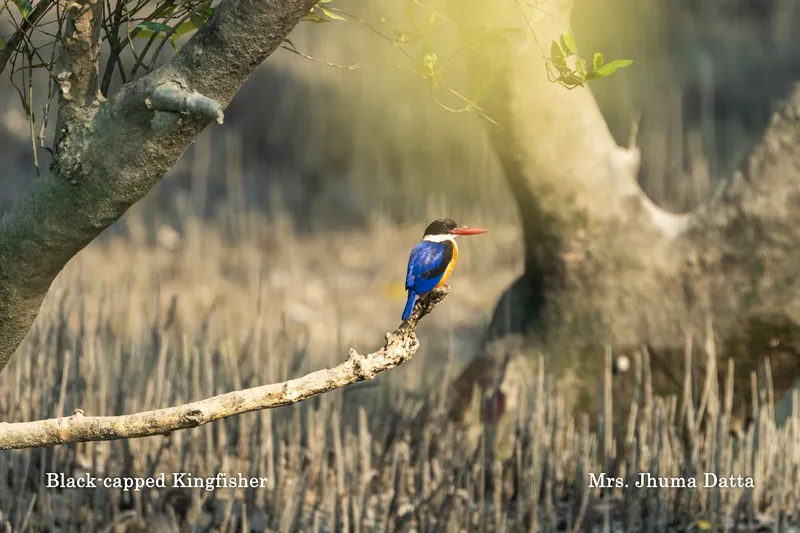
With 260+ bird species, Sundarbans is one of India’s finest bird photography destinations. The crown jewel: 7 kingfisher species, including the globally rare Brown-winged Kingfisher.
Best season: November to February — species count per day can exceed 60–80 on a single safari.

Photo Safari Experience
A Sundarban photo safari is fundamentally different from a sightseeing tour. Full day in the field — 5 AM to 5 PM, 12 hours of changing light. When wildlife appears, the boatman cuts the engine.
Maximum 8 guests — every photographer has full railing access, zero crowd noise.
Real Field Method
Sundarban Tiger Tracking & Photography Guide
In the Sundarbans, tiger tracking is a patient, skill-based boat expedition through rivers, creeks and mangrove edges — guided by reading the forest’s own language.
- Boat Safari & Creek Strategy — choosing the right creek route
- Reading Physical Signs — pugmarks, scat, scratch marks
- Alarm Calls — jungle language from deer and monkeys
- Tide Understanding — Neap Tide gives best visibility
- Wait & Watch — engine off, 1–2 hours silent stalking
- Territory Knowledge — guide updates from partner network
“A good team does not show you the tiger. They place you in the best possible situation to see one.”

Tiger Sighting Probability
✓ 3-Day Tour → Moderate sighting chance
✓ 4-Day Tour → Better probability
✓ Early morning (5–9 AM) → Peak activity
✓ Late afternoon (3:30–5 PM) → Second peak
✓ Neap Tide dates → Best conditions
✓ November–April → Highest season
Photography Subjects
What You'll Photograph in Sundarbans
Avoid These Mistakes
7 Things That Ruin a Sundarban Photography Tour
Most photographers return disappointed not because wildlife was absent — but because of avoidable planning errors.
Strong current from Amavasya/Purnima ±2 days makes the boat unstable, water muddy, and wildlife retreats from banks. The #1 cause of bad Sundarban photos. ✓ Fix: Always book on Neap Tide / Mra Kotal dates — see our calendar above.
Regular tours follow a fixed schedule and return early at 3 PM. A photography safari positions the boat for the shot, follows real-time wildlife intelligence and gives 12 full hours daily. ✓ Fix: Book a dedicated photo safari with a photographer guide.
Most operators start at 7–8 AM. By then the best light is gone and animals have retreated. The first 45 minutes of dawn are the most magical light of the entire tour. ✓ Fix: Confirm 5:00 AM departure before booking.
Noise alone drives wildlife away — every railing spot is taken and you cannot reposition for the shot. ✓ Fix: Maximum 8 guests is the correct limit for photography. Our tours never exceed this.
Wildlife is seen at 30–150 metres from the boat. Below 300mm you get tiny specks. Ideal: 400–600mm telephoto for wildlife, 16–35mm wide for landscapes. ✓ Fix: Bring 400mm+ as your primary lens.
No ethical wildlife tour can guarantee sightings. ~100 tigers in 4,000+ sq km of dense mangrove. Expert guides maximise probability — but wildlife is wild. ✓ Fix: Choose 4N/4D for best probability.
Forest Department keeps Sundarbans closed every Tuesday. Many travellers book without knowing this. ✓ Fix: Always confirm no safari day falls on Tuesday before booking.

Quick Gear Checklist
✓ 400–600mm telephoto (primary)
✓ 16–35mm wide-angle (landscapes)
✓ 100mm macro (optional, mudflats)
✓ 3+ fully charged batteries
✓ 64GB+ memory cards per body
✓ Waterproof camera bag (mandatory)
✓ Monopod or bean bag for railing
Right for You?
Who Should Join This Tour
When to Visit
Best Time for Sundarban Photography Tour
| Season | Tiger Activity | Bird Photography | Landscape | Rating |
|---|---|---|---|---|
| Oct – Nov | Good — post-monsoon | Excellent — migrants arrive | Lush green, misty mornings | Good Season |
| Dec – Feb ⭐ | Best — peak dry season | Peak — all migrants present | Clear skies, golden calm water | ⭐ BEST SEASON |
| Mar – May | Good — pre-summer | Good — pre-migration | Dry, warm, dramatic tones | Good Season |
| Jun – Sep | Monsoon tours available | Limited in some zones | Lush, atmospheric, moody | Monsoon Season |
Getting Here
How to Reach Sundarban from Kolkata
- Step 1: AC vehicle from Kolkata → Godkhali Jetty (3.5 hrs, ~100 km)
- Step 2: Boat from Godkhali → Forest Entry (official gateway)
- Step 3: Mechanised boat → Pakhiralay Resort (30–45 min)
📍 Kolkata Pickup Points
8:45 AM — Indian Museum Gate, Park Street Metro
9:15 AM — Science City, PC Chandra Garden Gate No. 1
✈️ Kolkata Airport / any address — by prior arrangement
⚠️ Important: The old Canning boat route is no longer reliable for tourists. Road transport Kolkata → Godkhali is the only recommended route. We handle all logistics door-to-door.
Distance from Kolkata
| Kolkata City | ~100 km / 3.5 hrs |
| Kolkata Airport (CCU) | ~85 km / 3 hrs |
| Howrah Station | ~95 km / 3.5 hrs |
Package Details
What's Included & Excluded
✅ Package Includes
- Full Day Boat Safari — 5 AM to 5 PM daily
- All Meals — Breakfast, Lunch, Snacks & Dinner
- Premium Stay — AC (summer) / Non-AC (winter) + geyser
- Kolkata / Godkhali Pick & Drop (as per package)
- Wildlife Photography Guide + Licensed Forest Guide
- 65 ft boat — upper-deck photography platform
- Forest permits, boat permissions, watchtower fees
- Evening Cultural Programme (Bonbibi folk, Jhumur dance)
- All taxes and service charges
❌ Not Included
- Personal camera equipment & accessories
- DSLR camera permits (if pro video / drone / heavy telephoto — confirm at booking)
- Travel insurance (strongly recommended)
- Personal expenses, tips & gratuities
- Non-Indian guest Forest Department permits
Cancellation Policy:
45+ days: 100% refund | 31–45 days: 50% refund
21–30 days: 25% refund | 11–20 days: Date adjust
Within 10 days: No refund
Child Policy:
Under 4 yrs: Free | 4–8 yrs: 50% | 8+: Full rate
45+ days: 100% refund | 31–45 days: 50% refund
21–30 days: 25% refund | 11–20 days: Date adjust
Within 10 days: No refund
Child Policy:
Under 4 yrs: Free | 4–8 yrs: 50% | 8+: Full rate
FAQ
Everything About Sundarban Photography Tours
Can’t find your answer? WhatsApp 6290006515 — we reply within 30 minutes.
October to March is the best season. December–February is peak: clear skies, calm rivers, maximum tiger activity and all migratory birds present. Always choose Neap Tide (Mra Kotal) dates for stable boat and clear reflections — see our calendar above.
A full-day wildlife boat expedition — 5 AM to 5 PM — designed entirely around photography, not sightseeing. The boat is positioned for the best shooting angles, following real-time wildlife intelligence. Upper-deck platform, professional guide, max 8 guests.
Yes — one of India’s finest. 260+ species, 7 kingfisher varieties (including the globally rare Brown-winged Kingfisher), White-bellied Sea Eagle, Painted Stork and dozens of migratory shorebirds November–February. Species count can exceed 60–80 per day.
Not guaranteed — no ethical wildlife tour can guarantee tiger sightings. Sundarbans has ~100 tigers across 4,000+ sq km of dense mangrove. Our guides read pugmarks, alarm calls and freshwater tracking points daily to maximise your probability. The 4N/4D package gives better probability.
400–600mm telephoto for tigers, birds and crocodiles. 16–35mm wide-angle for landscapes. Bring 3+ charged batteries, 64GB+ cards, and a waterproof bag. DSLR still photography is generally permitted under standard forest entry.
5:00 AM to 5:00 PM — a 12-hour window covering pre-dawn blue hour, golden sunrise, midday forest and golden-hour dusk. The route changes every day based on fresh tracking intelligence.
3N/3D: 3 full safari days — focused expedition covering core tiger zones and key creek systems. 4N/4D: 4 full safari days — deeper zone coverage, higher tiger sighting probability, Buffer Zone exploration, village photography. Serious photographers should always choose 4N/4D.
Godkhali-to-Godkhali: you arrange your own transport to Godkhali Jetty (~3.5 hrs from Kolkata). Kolkata-to-Kolkata: AC vehicle pickup from your address or airport and drop back — full door-to-door service.
Yes, completely. Our photographer guide provides hands-on coaching every day — camera settings, composition, wildlife reading, light management. Smartphone photographers equally welcome. Many of our best guest images were taken by first-time wildlife photographers.
Yes. Private tours available for individuals, couples, families and professional photographers. Duration, dates, zones and subjects can all be customised. Also available: 2-day quick expeditions and 5–6 day deep wildlife expeditions. WhatsApp 6290006515 for a custom quote.
Photo Gallery
Sundarbans Through the Lens
💬
WhatsApp (Fastest)
6290006515
Reply within 30 minutes
Book Your Spot
Book Your Sundarban Photography Tour 2026
Peak season dates fill quickly.
Secure your Neap Tide batch today.
30% advance confirms your slot.
📞
Phone
9883222335
Dayapur, Sundarbans
Gariahat Office, Kolkata